

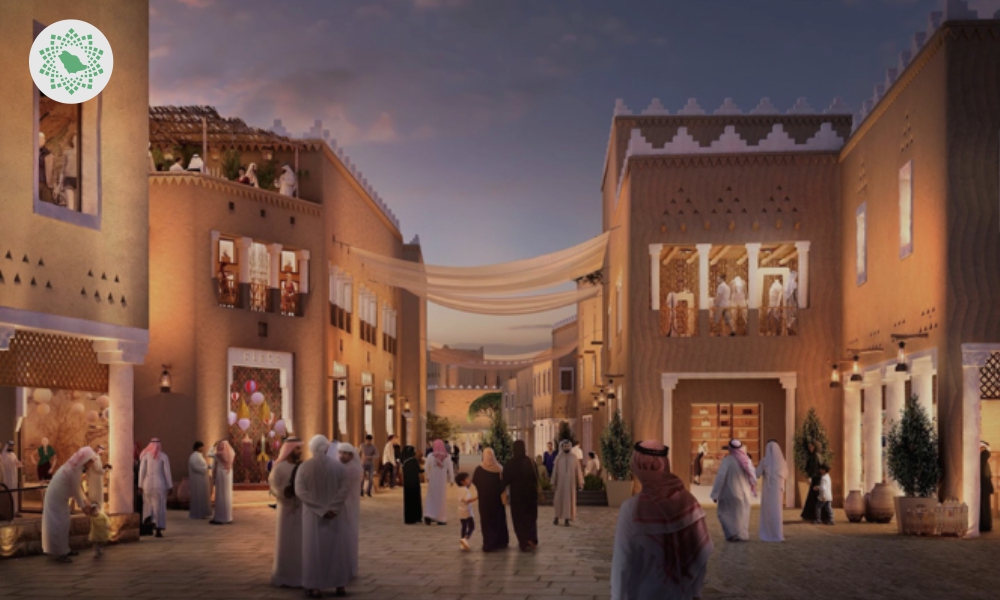
The historic district of At-Turaif, nestled in the heart of Diriyah on the western banks of Wadi Hanifah, is not merely a ruin; it is the genesis of modern Saudi Arabia. As the first capital of the Saudi Dynasty and the seat of the First Saudi State, its importance is unparalleled. This historical weight is formally recognized by its 2010 inscription as a UNESCO World Heritage Site. The responsibility of restoring and revitalizing this cultural jewel has been entrusted to the Diriyah Gate Development Authority, whose preservation mandate is a masterclass in blending reverence for the past with the demands of sustainable, modern development.
The Enduring Soul of Najdi Architecture
The structures of At-Turaif are perhaps the world’s most sophisticated and largest examples of Najdi architecture. This indigenous style, forged by the harsh, arid climate of the central Arabian Peninsula, offers profound lessons in sustainability and resilience. Built almost entirely of locally sourced mud-brick (adobe) and mud mortar, these buildings feature thick, tapering walls that provide natural insulation against the extreme heat.
The defining aesthetic is one of elegant simplicity: large, inward-facing courtyards designed for privacy and shade, narrow, winding sikkas (streets) that naturally cool the air, and striking triangular openings (Al-Mashash or Shamasa) along the top edges of the fortification walls. These were not just for decoration; they facilitated air circulation and provided defensive visibility. The materials mud, stone, and palm wood for roofing demonstrate an architectural dialogue with the environment that has survived for centuries, embodying Saudi identity and its early ingenuity.
The Preservation Mandate Under UNESCO
The challenge facing the Diriyah Authority is monumental: preserving fragile mud-brick ruins that were partially destroyed by an Ottoman assault in 1818, while simultaneously adhering to the strict international standards of the UNESCO World Heritage Convention
The UNESCO inscription dictates that the integrity and authenticity of the site must be preserved. For At-Turaif, authenticity means more than simply rebuilding; it means stabilizing ruins where they fell, preserving the scars of history as essential narratives. This process requires a highly specialized conservation philosophy known as “minimum intervention.” This means consolidation of the existing fabric takes precedence over reconstruction, ensuring that visitors witness the site’s history, including its destruction, rather than a modern interpretation of its glory.
In fulfilling this role, the Diriyah Gate Development Authority acts as a global steward, establishing a precedent for earthen architecture conservation. The mandate extends beyond the physical structures to encompass the cultural landscape, including the crucial Wadi Hanifah valley, which historically sustained the city’s inhabitants and palm groves
Engineering the Revival: A Laboratory for Conservation
The restoration work at At-Turaif has transformed the site into an “open-air laboratory.” The authority’s experts, including archaeologists, engineers, and heritage specialists, have innovatively combined ancient craftsmanship with cutting-edge technology.
Techniques demand meticulous fidelity to the original methods. Restoration teams utilize specialized mud-brick fabrication facilities on-site to produce millions of mud-bricks and plasters using the exact traditional composition a blend of earth, straw, and water to ensure compatibility with the centuries-old structures. This commitment to traditional construction techniques is essential because earthen structures cannot be repaired with modern materials like concrete, which would compromise the thermal performance and stability of the adjacent mud walls.
Furthermore, the project incorporates advanced digital documentation tools like Heritage Building Information Modeling (HBIM) and laser scanning. This allows the Diriyah Gate Development Authority to create precise digital catalogs of every architectural element and monitor decay patterns with AI, enhancing conservation quality and structural integrity assessments without resorting to destructive manual inspections. This use of technology, while maintaining aesthetic tradition, highlights the organization’s Expertise and Trustworthiness in managing such a high-profile global asset.
Conclusion
The successful preservation of At-Turaif serves as the crucial cultural anchor for the wider Diriyah development. The architecture and principles established by the Authority have inspired the design codes for all surrounding areas, including the adjacent Bujairi Terrace, ensuring modern development aligns with the authentic Najdi vernacular, a seamless blend of past and future.
This integrated approach is the essence of Saudi Arabia’s Vision 2030, which aims to diversify the economy by transforming culture and heritage into a key pillar of tourism. By conscientiously preserving its birthplace, the Diriyah Gate Development Authority ensures that the restored site is not just a monument but a dynamic, living entity that drives economic and cultural pride. The meticulous effort invested today guarantees that the stories held within At-Turaif’s mud-brick walls will inspire generations of architects, historians, and visitors worldwide.
Link guidelines:
- Please homepage link of UNESCO World Heritage Site.